Performance-Driven Digital Marketing Agency for Predictable Business Growth
The question usually arrives late.
Not at the beginning of growth, but after pressure has already built. Paid spend is rising. Marginal returns are tightening. SEO is either underdeveloped or overburdened.
At that point, someone asks:
Should we be investing more in SEO or doubling down on ads?
The problem isn’t the question. It’s the timing.
Paid acquisition is chosen for a reason. It delivers control, immediacy, and clarity. When demand needs to be activated quickly, it works.
But speed has a cost. The faster growth is forced through paid channels, the more fragile the system becomes. Spend increases, but resilience doesn’t.
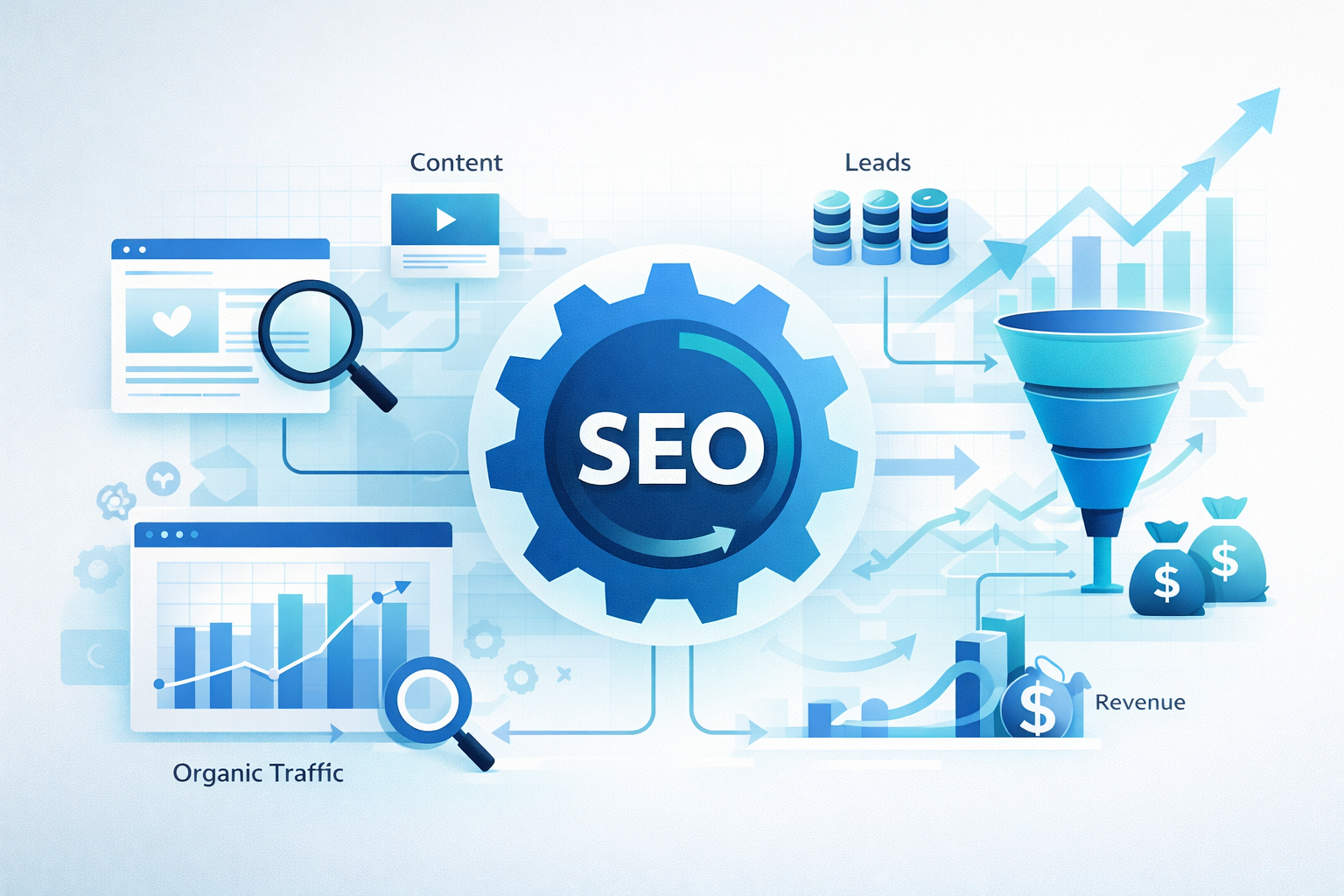
SEO enters this conversation not as an alternative but as a counterweight.
SEO doesn’t provide the same immediacy. It compounds slowly, builds credibility gradually, and resists precise forecasting early on.
This makes it uncomfortable in environments optimised for short-term certainty.
As a result, SEO is often:
In both cases, imbalance grows.
The real risk isn’t choosing SEO or paid ads. It’s allowing one channel to carry responsibility it wasn’t designed for.
That risk typically shows up as:
At that stage, cost increases while optionality decreases.
Mature growth systems don’t force equivalence. They allow each channel to do what it does best.
Paid acquisition tests, accelerates, and scales. SEO stabilises, compounds, and absorbs volatility.
When insights flow between them, efficiency improves. When they operate independently, fragility increases.
The useful question isn’t which channel performs better.
It’s:
Where is risk concentrating and where should it be redistributed?
When that question is answered honestly, the roles of SEO and paid ads become clearer. Not as competitors, but as complementary mechanisms inside the same system.