Performance-Driven Digital Marketing Agency for Predictable Business Growth
Google Ads covers the full funnel, from awareness to demand capture. We focus on where it performs best converting high-intent searches into measurable growth.

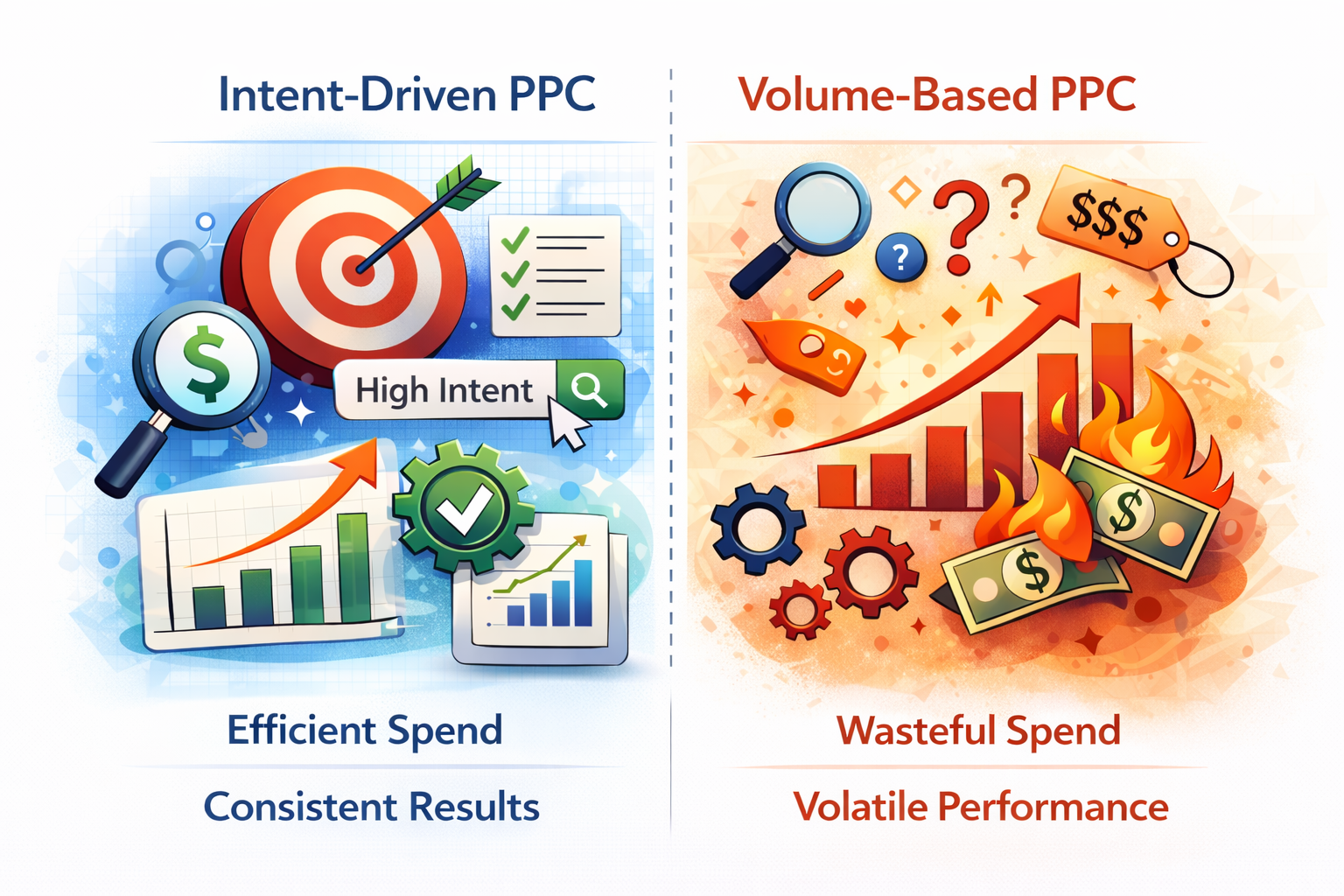
Google Ads becomes expensive quickly when intent is treated as interchangeable. High-intent searches, research queries, and casual comparisons are often managed the same way, even though they behave very differently. When that happens, spend scales faster than results, performance becomes harder to justify, and optimization turns reactive instead of deliberate.
Our Google Ads work exists to prevent that. We execute PPC with discipline so high-intent demand is captured efficiently and low-leverage spend is contained. This isn’t generic PPC management or keyword expansion dressed up as strategy. It’s Google Ads execution governed by intent, designed to produce stable, explainable performance.
We identify the search terms that signal immediate purchase intent. These are the queries most likely to convert not just generate clicks so budget is aligned with revenue from day one.
Not all demand deserves the same spend. We separate high-intent, high-value searches from research and comparison traffic, deciding what to scale aggressively, what to test carefully, and what to exclude entirely.
Campaigns are built around conversion probability, not keyword lists. Ad groups, match types, and bidding strategies are structured to capture demand at the exact moment users are ready to buy.
With intent-led structure in place, optimization becomes predictable. We increase spend only where conversions justify it keeping CPA stable while scaling revenue, not noise.
Most Google Ads accounts fail in predictable ways.
Spend grows faster than understanding.
Keywords multiply faster than performance is evaluated. Optimization improves surface metrics while cost per acquisition rises.
The issue isn’t bidding strategy or match types. It’s a lack of prioritization.
PPC rewards focus. Most accounts are built to ignore that.
When Google Ads execution is governed correctly:
Google Ads stops feeling volatile and starts behaving like infrastructure.
You won’t see us chasing every keyword, launching every campaign type, or reacting to every fluctuation in spend.
You’ll see:
1
Fewer keyword and bid changes made deliberately
2
Budget shifts tied directly to revenue and lead quality
3
Clear explanations of what’s driving results
4
Adjustments when search behavior contradicts assumptions
If your Google Ads performance feels expensive, volatile, or difficult to justify, the solution isn’t more keywords or more automation.
It’s tighter control over intent.
We’ll assess which PPC spend creates leverage, which creates drag, and what should remain stable even when performance fluctuates.
Google Ads works best when there is existing demand for what you sell. If people are actively searching for your product or service, it can be one of the fastest ways to generate qualified traffic, leads, or sales. If demand is limited, results depend more on positioning, offer strength, and supporting channels.
Most accounts show early signals within the first 2–4 weeks. Stable, predictable performance typically takes 6–8 weeks as enough data accumulates to make informed bidding, budget, and keyword decisions. Immediate results are possible, but consistency matters more than speed.
There is no universal minimum, but budgets need to be high enough to generate meaningful conversion data. For most businesses, this starts at a level that allows at least a few conversions per week. We focus on efficiency first, then scale only when returns justify it.
Yes — including Search, Performance Max, Shopping, Display, YouTube, and remarketing. That said, we don’t use every campaign type by default. We choose formats based on your goals, demand level, and where Google Ads can realistically drive impact.
Keyword decisions are based on intent, not volume alone. We prioritize searches that indicate buying or decision-making behavior and continuously refine targeting using search term data, not assumptions.
Yes. You retain full ownership of your account, data, and history at all times. We work transparently within your account, so you can see exactly what’s being done and why.
Success is measured against business outcomes, not surface-level metrics. Depending on your goals, this may include revenue, cost per acquisition, lead quality, conversion rates, or return on ad spend — not just clicks or impressions.
We don’t optimize for activity. We optimize for impact. That means fewer, more deliberate changes, clearer reasoning behind decisions, and a focus on what actually moves performance — not constant tinkering.
Yes, as long as expectations align with reality. With smaller budgets, the focus is on efficiency, learning, and validating demand — not aggressive scaling. We’ll tell you upfront what’s realistic.
Access to your Google Ads account, conversion tracking (or the ability to implement it), and clarity on your business goals. From there, we handle strategy, execution, and ongoing optimization.