
Performance-Driven Digital Marketing Agency for Predictable Business Growth
We bring control to paid search by grounding decisions in intent, prioritization, and financial context so spend works toward outcomes, not urgency.
Our paid ads work spans both Google Ads and Meta Ads, structured around intent, prioritization, and financial clarity not platform-specific tactics.
We structure paid search around intent, prioritization, and financial context so spend captures demand deliberately, not reactively. Campaigns are designed to be explainable, controllable, and aligned to outcomes that matter beyond clicks.
We use Meta to shape and qualify demand earlier in the journey reinforcing positioning, filtering audiences, and supporting downstream conversion quality. Creative, targeting, and spend are structured to reduce noise, not inflate volume.
We don’t treat paid media as a collection of tactics.
Spend is organized around intent, not volume
Each campaign has a defined role within the account
Scaling decisions are sequenced, not rushed
Pausing or stopping spend is treated as progress, not failure
That discipline is what turns paid ads into a controllable growth mechanism.
You won’t see us chasing every audience or scaling every campaign at once.
You’ll see:
1
Fewer spend decisions made deliberately
2
Budget changes tied directly to business outcomes
3
Clear explanations of what’s driving performance and what isn’t
4
Adjustments made when data contradicts assumptions
The work is calmer than most paid media engagements.
The impact isn’t.
SEO builds durability. Paid search buys immediacy.
When aligned, paid search validates intent quickly while SEO absorbs long-term demand. Dependency decreases instead of growing.
When misaligned, both channels suffer.
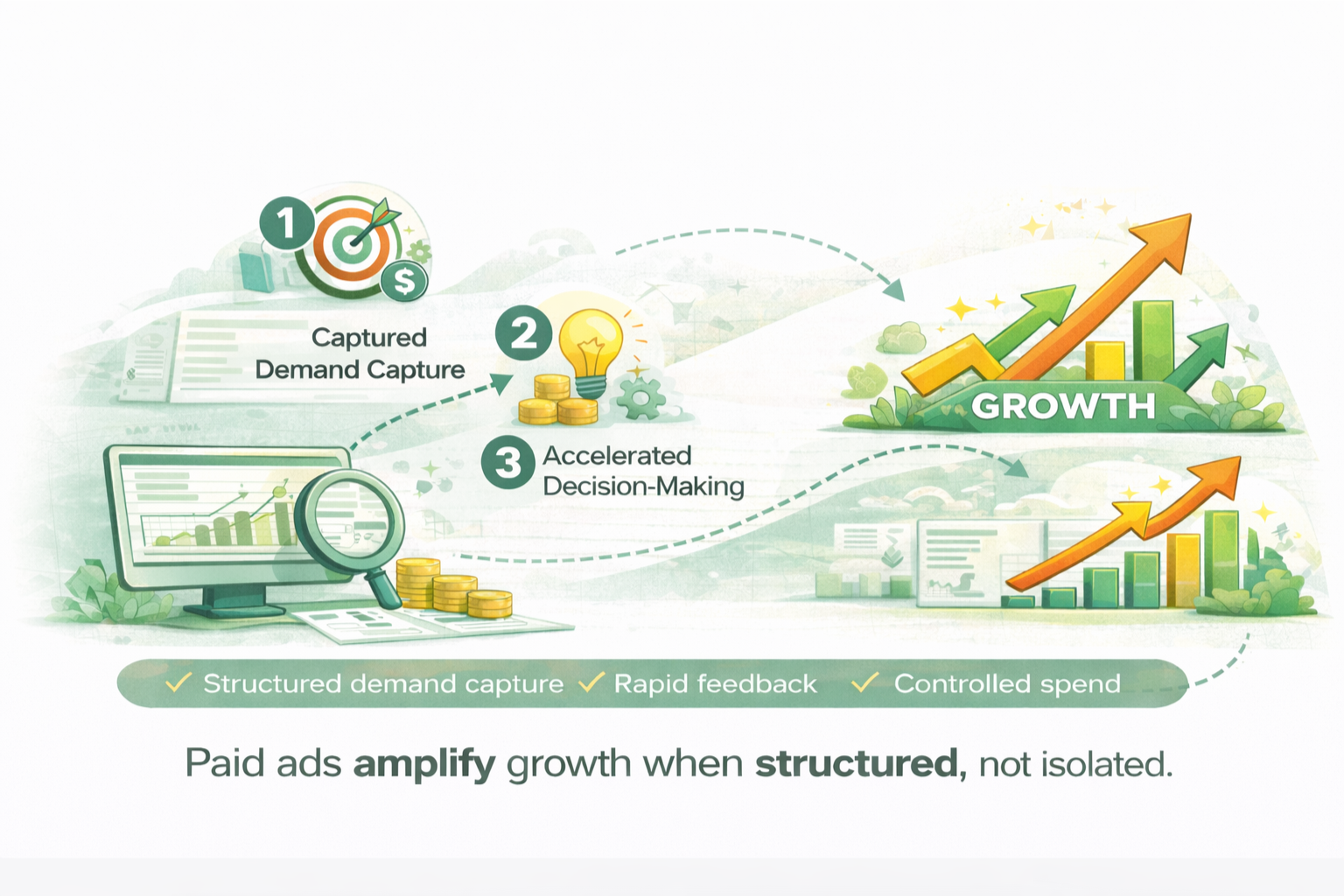
Paid advertising introduces speed and control where growth needs acceleration. When structured well, it enables precise demand capture, faster learning cycles, and disciplined budget allocation across the funnel.
Used intentionally, paid spend sharpens positioning, validates direction, and supports confident scaling. Used without structure, it creates volatility that obscures signal and erodes trust in performance.
If paid media feels reactive, volatile, or difficult to justify, the solution isn’t more optimization.
It’s fewer decisions made deliberately.
We’ll identify where spend creates leverage, where it doesn’t, and what should remain stable even when numbers move.
We work primarily with Google Ads and Meta Ads, using each where it performs best within the buying journey. Platform choice is driven by intent and business context, not preference.
We don’t optimize for motion. We optimize for control and clarity. That means fewer moving parts, clearer budget logic, and performance that can be explained without hiding behind dashboards.
It’s best suited for teams already spending on paid media who want more stability, better decision-making, and higher-quality demand, especially in competitive environments.
Paid ads surface signal quickly, but reliable performance comes from disciplined iteration and thoughtful scaling, not constant restructuring.
Budgets are allocated based on intent strength, incremental return, and business priority, not platform suggestions or legacy spend patterns.
We don’t choose by channel—we choose by role. Search is typically used to capture existing demand, while paid social supports positioning, qualification, and early-stage influence.
Success is measured by commercial impact—demand quality, contribution to pipeline, and efficiency over time—not surface-level engagement metrics.
Only when there’s a clear question to answer. Testing is purposeful and limited, designed to create insight—not activity.
Typically no. This model assumes existing demand, budget maturity, and internal alignment around growth priorities.
We start by clarifying what paid ads should solve, where spend is losing control, and what deserves focus before any execution begins.