
If you’re here, you already know SEO matters.
What you’re questioning is whether it’s worth the attention it consumes.

SEO

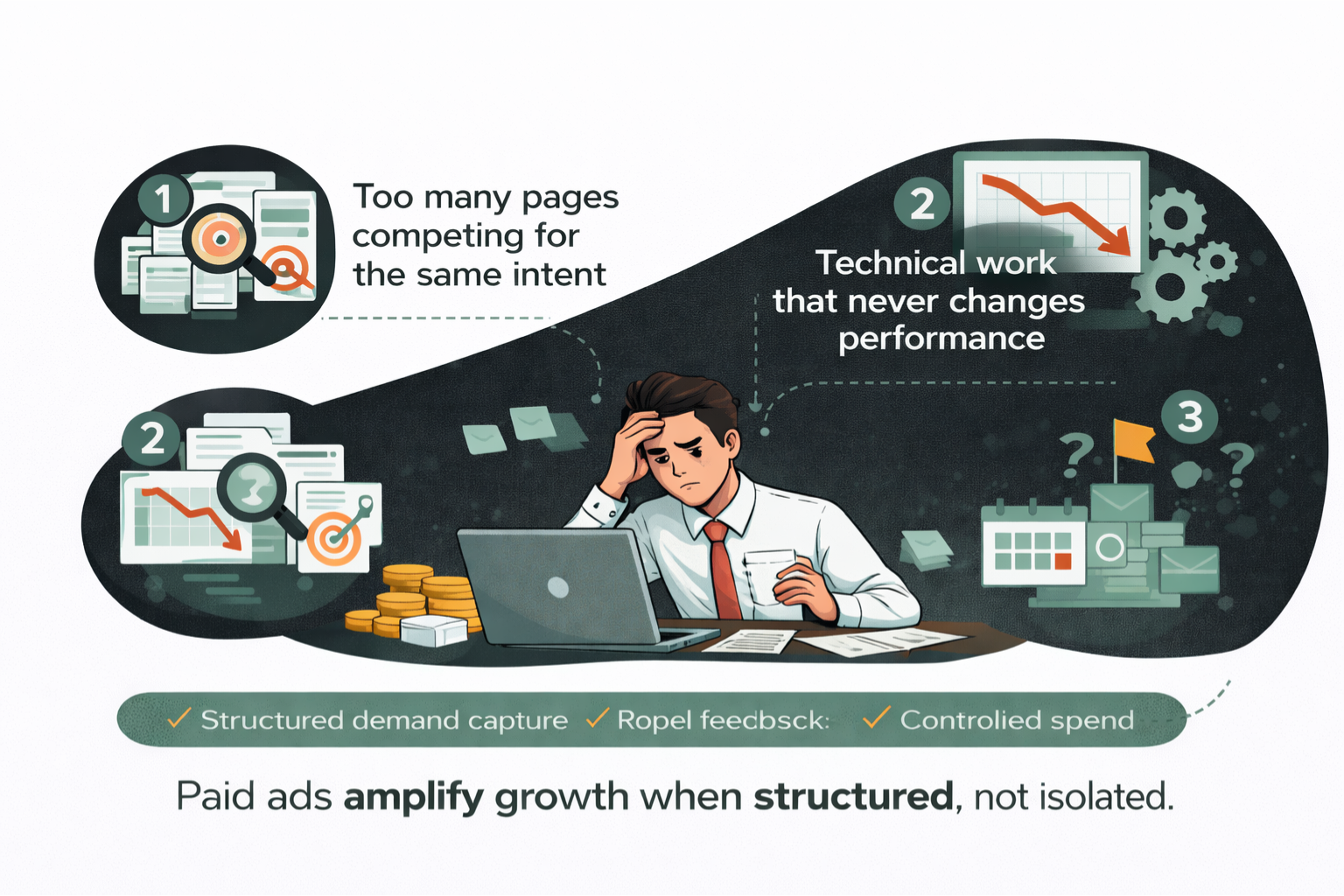
SEO fails when too many decisions are made without focus and no one owns the trade-offs. 
Our work exists to make SEO predictable, governable, and commercially accountable.

What SEO Solves At The Leadership Level

Leadership actually needs from SEO is clarity.

That means knowing where effort creates leverage, where it doesn’t, and how SEO decisions connect to revenue, forecasting, and risk not just rankings or activity.

Our role is to turn SEO from an open-ended initiative into a system leadership can understand, govern, and trust.

At the leadership level, SEO isn’t judged by rankings or traffic alone it’s judged by whether it produces predictable business outcomes.

When strategy is unclear, SEO quietly consumes time, budget, and internal attention while creating little confidence in decision-making.

How we Structure SEO

  1. We don’t sell on-page, technical, or off-page SEO as isolated services.
  2. Each layer has a role. None of them operate independently.
  3. Most agencies optimize in parallel. We operate through priority deciding what deserves attention now, what can wait, and what should be ignored entirely.
  4. That discipline is what makes SEO predictable over time.

SEO Capabilities

SEO works when its components reinforce each other. We structure work across four areas, each solving a different constraint.

On-Page SEO

We refine the pages that actually influence decisions — aligning search intent, positioning, and internal structure so rankings translate into qualified demand, not empty traffic.

Off-Page SEO

Authority isn’t built through volume. We focus on relevance, defensibility, and signals that compound over time — without tactics that collapse under scrutiny.

Technical SEO

We remove constraints that limit visibility and scale. Architecture, crawl control, and performance decisions are made with one goal: enabling priority pages to win consistently.

Local SEO

When location influences buying behavior, we structure local visibility around intent, trust, and accuracy — not templated pages or artificial signals.
What This Looks Like in Practice

You won’t see us chasing every keyword or fixing everything at once.

You’ll see:

1

Fewer priorities chosen deliberately

2

SEO decisions tied directly to commercial outcomes

3

Clear explanations of what matters and what doesn’t

4

Adjustments made when data contradicts assumptions

The work is quieter than most SEO engagements.
The impact isn’t.

This SEO Works For

  1. Already have product–market fit
  2. Compete in crowded or competitive markets
  3. Care about lead quality over volume
  4. Want SEO to support revenue, not distract from it

SEO’s Role in the Growth System​

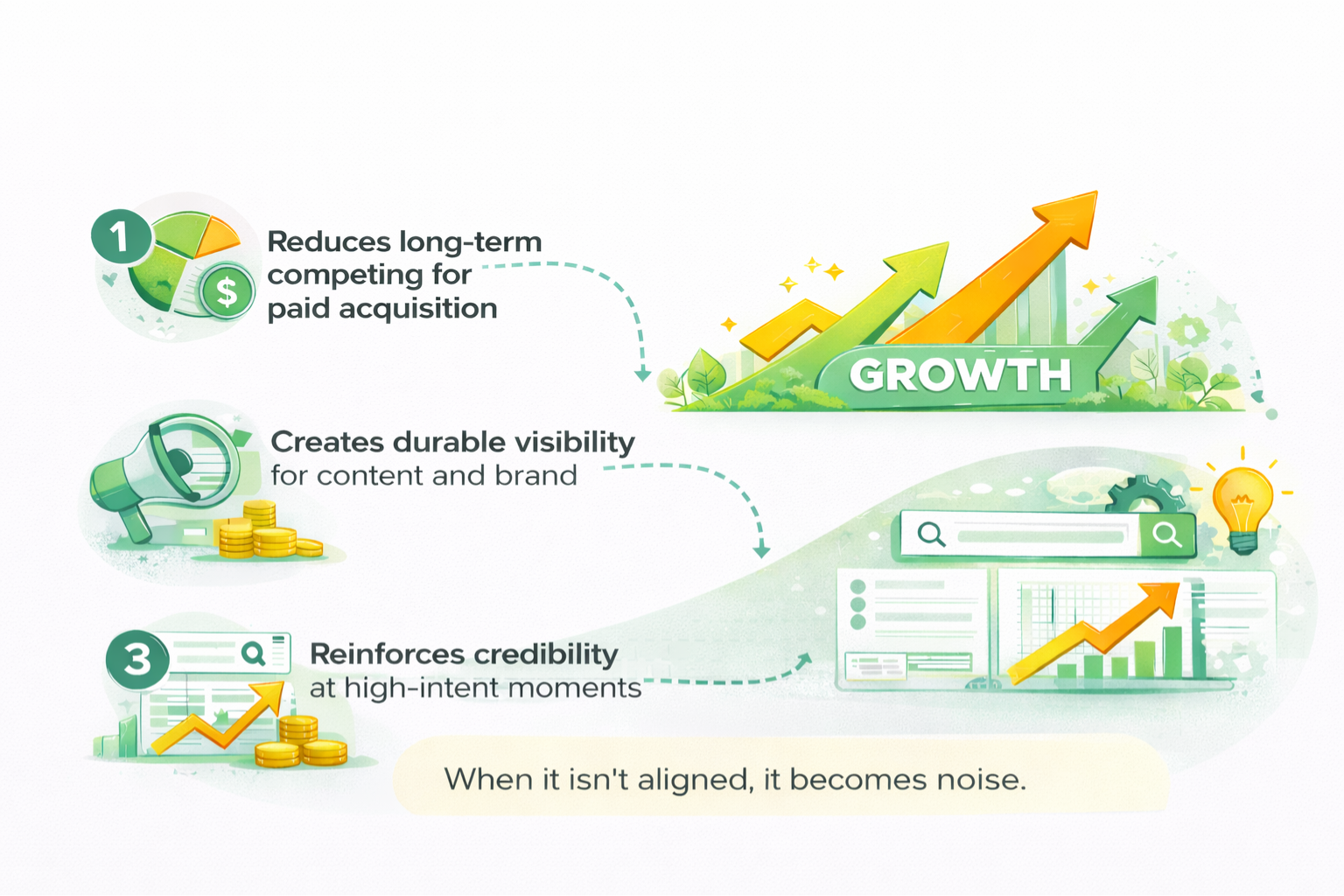
SEO doesn’t operate in isolation. When structured properly, it supports acquisition efficiency, brand visibility, and demand quality across the funnel.

Aligned SEO reduces long-term reliance on paid channels, creates durable visibility for content and brand, and reinforces credibility at high-intent moments. When it isn’t aligned, it becomes noise instead of leverage.

Start With Clarity

If SEO feels unpredictable, overly complex, or disconnected from outcomes, the next step isn’t more execution.

It’s deciding:

  1. Whether SEO is actually your constraint
  2. Where it fits in your growth model
  3. What’s worth prioritizing — and what isn’t

Strategy, prioritization, and accountability remain senior-led throughout the engagement.

No obligation. Clear next steps. No performance theatre.

FAQ

Traditional SEO focuses on activity. This approach focuses on predictable business outcomes by structuring priorities, ownership, and execution around what actually drives growth.

Companies with product-market fit that compete in crowded markets and care more about qualified demand and revenue impact than raw traffic.

SEO compounds over time. Early signals appear within months, but sustainable impact comes from consistent, focused execution, not quick fixes.

When structured correctly, SEO creates durable visibility that lowers long-term dependence on paid acquisition and improves efficiency across channels.

We prioritize based on business constraints, not volume of tasks—focusing effort where it will change outcomes, not just metrics.

Yes—but they’re not sold or executed in isolation. Each plays a role within a single system, sequenced based on impact, not checklists.

Success is tied to commercial outcomes—demand quality, pipeline contribution, and growth efficiency—not rankings alone.

Usually not. This model works best for teams ready to prioritize, say no to low-impact work, and commit to long-term leverage.

The system adapts without losing focus. Decisions remain deliberate, documented, and aligned to business goals as conditions evolve.

Clarity. We start by identifying where SEO fits in your growth system, what’s worth prioritizing, and what should be ignored.